
Safe Transfer sends files behind an identity check. The recipient proves who they are, with ID Austria or WebID, before anything unlocks. Email attachments and shared links do not do that: anyone who ends up with the message ends up with the file.
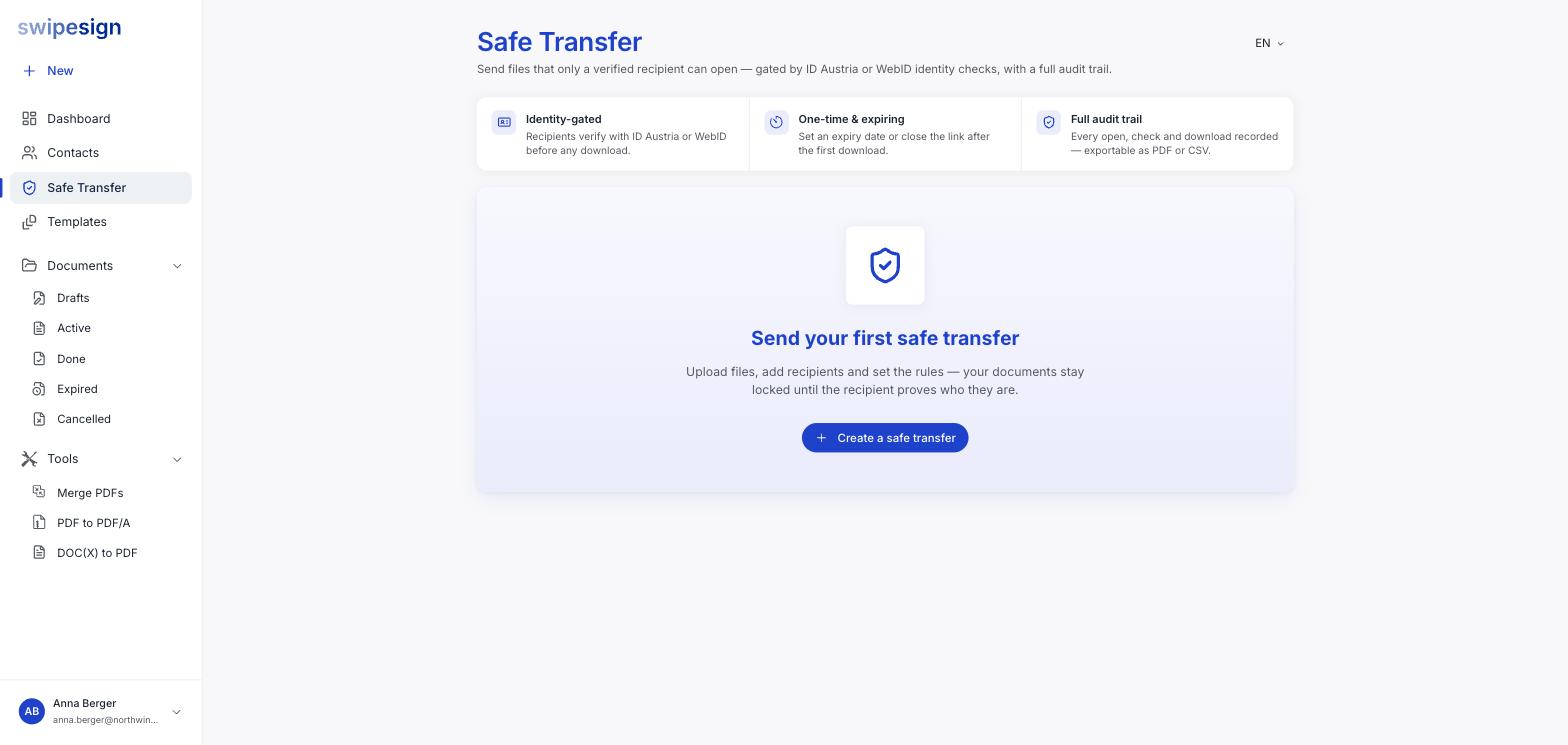
What you get
| What it means | |
|---|---|
| Identity-gated | Each recipient verifies with ID Austria or WebID before any download. Not a password you both have to remember: an actual identity check. |
| One-time & expiring | Set an expiry, or close the link automatically after the first successful download. |
| Full audit trail | Every open, identity check and download is recorded, and exportable. |
When to reach for it
Anything where the wrong person receiving it is the problem: payroll, medical records, due-diligence packs, board papers, anything covered by an NDA. Also anything where you need to be able to prove afterwards that only the intended person got it.
For an ordinary attachment nobody would mind seeing, it is overkill, and it comes out of a monthly allowance. See What Safe Transfer costs.
How it differs from sending a document for signature
| Signature workflow | Safe Transfer | |
|---|---|---|
| Purpose | Get something signed | Get something delivered securely |
| Recipient does | Reads and signs | Verifies identity and downloads |
| File types | PDF, DOC, DOCX | PDF, Word, Excel, PowerPoint, JPG, PNG |
| Size limit | 200 MB per file | 100 MB per file |
| Cost | Comes out of your signature allowance | 10 transfers a month included in the subscription, then per transfer |
They can be the same document
Nothing stops you signing something and then sending the signed copy by Safe Transfer, which is exactly what you would do with an executed agreement that shouldn't sit in an inbox.